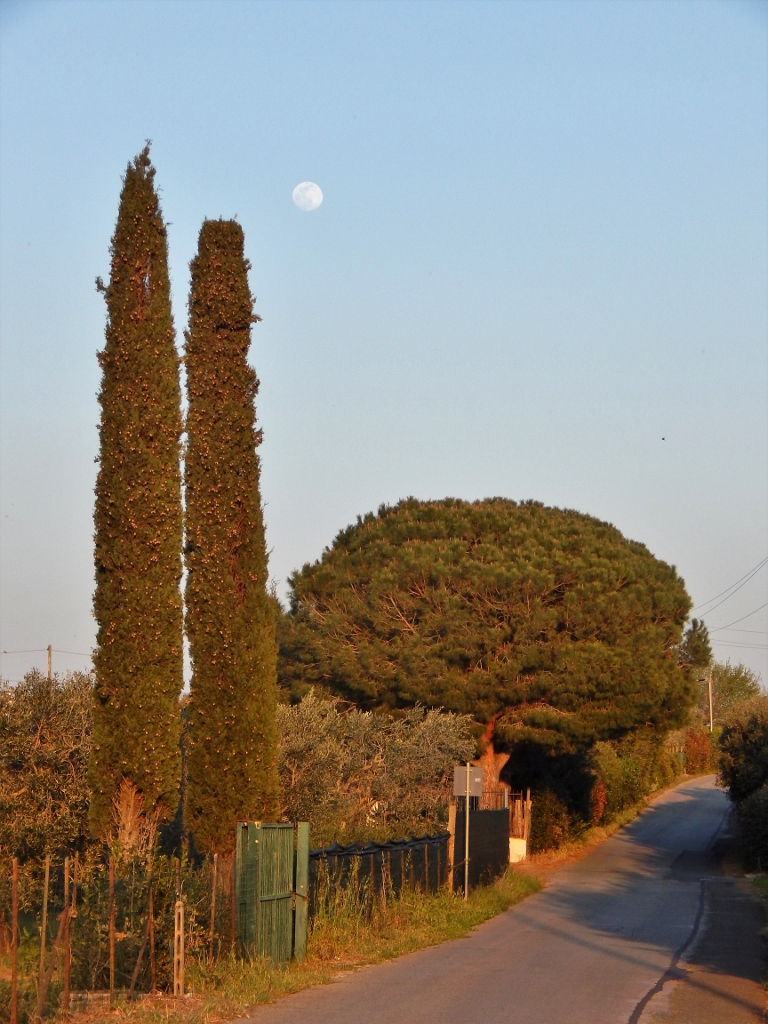
I liked putting my words in somebody else’s mouth, and today prompt asked us to do just this. Here is my non-translation with the last full moon watching in something like approval.
.
U
n
d
e
r
s
t
a
n
d
i
n
g
.
Prompt 21: “Find a poem in a language that you don’t know, and perform a ‘homophonic translation’ on it. What does that mean? Well, it means to try to translate the poem simply based on how it sounds.”
Today I read a poem about how we should not be writing poems every day because in this way we produce a lot of fluff. The person who wrote it writes daily poems for NaPoWriMo just like the rest of us. Maybe own advice ought to be followed.
When I had a look at today’s source Poetry International, I knew that for today’s exercise I had to find a language I know nothing about and lo, a poem in Albanian glides by. The English translation was right next to it but I did my best to not even glance at it and do my own “translation”. Here it is, followed by the original poem in Albanian, and at the end there is the proper English translation.
“Shaloj”, which is repeated in every stanza, looked like “shallow” to me, whereas in fact it is “saddle”.
The understanding is mine
Do not wade in the shallow water,
my mother told me,
you might fall or a crab might pinch you.
Do not go in the shallow woods,
that is where the devil lurks,
warned the priest.
Do not read by the shallow light,
my father advised,
you will ruin your eyes.
Do not wish for a shallow grave,
aunts and uncles agreed,
there is no escape from the dark hole.
Do not surround yourself with shallow people,
said grandpa and grandma,
whom I obeyed the most.
Do not speak shallow words,
life taught me – they always return
and demand to be buried deeper.
Udhëtimet e mia
by Xhevahir Spahiu, 2001
Do ta shaloj renë
të shkoj mbi malet e mia,
po deshën shi, t’u derdh pika lotësh.
Do ta shaloj kalin
të ndiej shijen e erës
kur dashuria më pret.
Do ta shaloj lumin
të më çojë në det,
të mbaj mbi vete anijet.
Do ta shaloj pemën
mos pikëllohet pa zogjtë,
rrënjët t’i ngulen më thellë në tokë.
Do ta shaloj ëdrrën
pa yzengji dhe pa fre,
të më çojë tek e nesërmja.
Do ta shaloj këngën,
zot i saj, rob i saj, – t’i këndoj
lëvizjes dhe nga pika e vdekur.
My travels
Translated by John Hodgson
I will saddle a cloud
to ride above my mountains,
if they want rain, I will drench them with tears.
I will saddle a horse
to feel the taste of the wind
when love is waiting for me.
I will saddle a river
to carry me to the sea,
and will bear ships on my back.
I will saddle a fruit tree
so it does not grieve without birds,
and its roots sink deeper into the earth.
I will saddle a dream
without stirrups or reins,
to carry me to tomorrow.
I will saddle a song,
its master and its slave – to sing
of movement even from the still point.
This is how the last, supposedly largest full moon in this year looked down upon us on April 6th. I think it was benevolently. This was at 7 pm. In the next few days I looked up in vain. The moon was gone.



 Manja Mexi Mexcessive (closed)
I love your poem. Way better than the original. I also like the prompt method. It sparks serendipities.
LikeLiked by 2 people
Thank you so much, Claudia, but this was not a contest to write better than him. 🙂 I didn’t even look at the translation before writing mine. Yes, I agree about the fun method. I saw that some people complained about it because they felt like the original poem is in this way somehow diminished. I disagree with them. It’s just fun.
LikeLiked by 1 person
I probably should have said, reading the original and reading yours, yours appealed to me much more. It spoke to what is in me and gave me fresh thoughts that the original didn’t. I really love the directness combined with the insight into the mysterious side of things your writing always has. I think this prompt method actually compliments the original author. If not for him/her there wouldn’t have been your poem, it is not a taking away but an adding to the world. Not to mention, fun!
LikeLiked by 1 person
“directness combined with the insight into the mysterious side of things your writing always has” Uuuu! This sounds… good! 🙂 Thank you for this description, Claudia. I’d put it on a blurb. Maybe I need to create one for my blog. I like to add to the world. 🙂
LikeLike
I love how the word ‘shallow’ adapts to different contexts in your poem–and means slightly different things. Very strong ending. The pictures of the full moon are out of this world!😍
LikeLiked by 2 people
Thank you so much, Romana! It’s amazing how quickly I had all these meanings assembled. This poem just poured out of me. I’m glad you like the moon too. 🙂
LikeLiked by 1 person
I love your poem with all its new meanings. Yes, I can definitely see how the word “shallow” stands out.
I also think the “real translation” is amazing, so I have to read more Xhevahir Spahiu poems now.
LikeLiked by 1 person
Thank you, Nataša! I’m so glad you like it and the original as well. I like to give people a push in the right direction. 🙂
LikeLike
The poem you created was outstanding! The original was wonderful as well.
LikeLiked by 1 person
Thank you so much for loving it, Irma! 🙂 I chose it only because it was Albanian and fully foreign to me.
LikeLiked by 1 person
I too like both poems. Repetition can lead to so many interesting insights, as you turn the word over and over. (K)
LikeLiked by 1 person
Thank you, K. Yes, I was lucky to choose a poem with a repeated word. After that I just ran with it.
LikeLiked by 1 person
👍
LikeLiked by 1 person
Dienkuju! (Or is this Czech?)
LikeLike
Poland😚💕
LikeLike
I love what u did with the poem.
LikeLiked by 1 person
Thank you, Bojana. I’m glad!
LikeLiked by 1 person
I love that first photo of the moon.
LikeLiked by 1 person
Thank you, Dan. I was hoping for more nights with the mood modelling, but it completely disappeared.
LikeLiked by 1 person
❤️ lovely, your version
LikeLiked by 1 person
Thank you, SMSW. Interesting that some people complained about this prompt, as if it’s impolite to the original poet to do this. I don’t agree. I think it’s healthy fun.
LikeLike
Reblogged this on Monique L. Desir and commented:
Manja’s beautiful and haunting poem was birthed using this method: “Find a poem in a language that you don’t know, and perform a ‘homophonic translation’ on it. What does that mean? Well, it means to try to translate the poem simply based on how it sounds.” Oooh, this sounds like so much fun! I also learned that NaPoWriMo is another way to celebrate National Poetry Month. I participated this year with Haikubes, but this route seems even more exciting. I’ll probably mix and match! 🙂
LikeLiked by 1 person